Showing posts with label baby. Show all posts

Saturday, October 26, 2013

Oral Motor Development: The Baby Steps

What is oral motor development? 
Oral motor development simply involves the use of lips, the tongue, the jaw, the teeth and the hard and soft palates. Proper movement and coordination of these structures are crucial in speech production, safe swallowing, and consuming different food textures. Consistent oral motor activity begins prior to birth and continues beyond age three. By age four, most children can safely consume solid and liquid food without choking.

The milestones I'm about to list are typical, they are not strict by any means and all infants develop at their own rates. Use these milestones as a guide in monitoring your child's progress toward oral motor and swallowing development. It is suggested you consult your pediatrician before introducing new foods to your baby.

Before birth, the baby begins to develop sucking reflexes (around 36 weeks).

From birth to 3 months old, a baby will:
  • Demonstrate many reflexes to protect his/her airway
  • Respond to stimulation in and around the mouth
  • Turn his/her head toward the nipple when a caregiver strokes his/her cheek (this is a sign for "I'm hungry")
  • Consume breast milk or formula using a nipple
  • Coordinate his/her breathing with two to three sucks of liquid before swallowing and breathing
From 3 to 6 months, the baby will:
  • Bring both hands up to clasp the bottle, but may need assistance holding it
  • Consumes rice cereal or pureed fruit and pureed vegetable baby foods
  • Eats from a small infant/toddler spoon during feeding
From 6 to 9 months, the baby will:
  • Hold the bottle independently
  • Clean the spoon with their upper lip (get the whole airplane up in there)
  • Eat pureed meats and a variety of pureed baby foods (pureed is a strangely spelled word)
From 9 to 12 months, the baby will:
  • Show lip closure when swallowing liquids and soft solids
  • Begin to self-feed by using his/her fingers to grab small food. The baby may attempt this with small, soft and easily dissolvable foods. Now I want Cheerios -_-
  • Begin experimenting with a sippy cup
  • Begin to consume mashed table foods
  • Drink from the sippy cup and attempts to hold the handle by his/herself
  • Drink through a straw
At 12 to 18 months, the baby will:
  • Coordinate his/her sucking, swallowing, and breathing patterns for longer sequences
  • Eat finely chopped table foods
  • Bite through crunchy foods, like cookies or crackers
  • Move the food in her/her mouth from side to side as they chew
At 18 to 24 months, the little one will feed him/herself using a spoon, but still may need assistance with this.

At 24 to 36 months, the medium one will:
  • Eat and drink a variety of solids and liquids through a straw and open mouth cups
  • Use a spoon to scoop soft foods while feeding him/herself 
  • Independently move toward find tuning all feeding skills
At 36 to 5 years, the large one will:
  • Progress toward chewing and swallowing more advanced textures such as meats, fried foods, whole fruits, etc. with close supervision by a caregiver
  • Begin to use a fork to stab food (also, with supervision)
  • Drink from an open mouth cup with no assistance
If this sounds like a lot to coordinate, look forward to the little things. Like catching this candid face on camera:
Resources
Richmond, Megan-Lynette. Super Duper Handy Handouts (2016): "Oral Motor Development Milestones"

Tuesday, September 24, 2013

Why To Teach Your Infant Simple Sign Language: A Must Read

At Suffolk Center for Speech, children with language disorders are often taught simple sign language (not standard ASL) to help them in overcoming their speech disabilities and communicate their needs in a more concise manner. It's a proven aid for children with speech difficulties, but what can it do for an infant whose hearing and speaking is healthily developing? Two words: a lot!

Before babies can even coordinate their lips, tongues, and voices to speak, they understand what is spoken to them. During their development, they learn the meaning of some words before they have the physical ability to voice them. Just because they cannot verbalize it, though, doesn't mean they can't somehow convey it. Teaching your infant simple ways to state their needs via an easily recognizable platform of signs can do wonders for their speech development.

Longitudinal psychological studies on infants have suggested that teaching an infant to sign before they can speak not only helps them learn to talk, but offers them advantages even later in life. Dr. Linda Acredolo and Dr. Susan Goodwyn compared two groups of children: a group taught to sign early in life to a group never taught to sign.

This longitudinal research showed that children who were taught to sign as babies were talking at a 4-year-old level at just 3 years of age. The study also showed that the group of children taught to sign as babies scored higher on intelligence tests later in life than those never taught to sign. At 8 years of age, children taught to sign as babies scored an average of 12 points higher on intelligence tests than children never taught to sign. Additionally, the babies who were taught to sign displayed less aggressive tendencies, were less frustrated and more self-confident.

Perhaps this is because at any early age, they learned to express their needs and wants to their authority figures by merely using their hands (while they had not yet learned to verbally express their needs and wants). From a general standpoint, teaching an infant to sign at an early age promoted positive emotional development. Several follow up studies confirmed the same results: more advanced language skills, higher scores on intelligence tests, increased self-confidence, decreased frustration, and more positive interactions with parents and other infants (Acredolo and Goodwyn, 2000).

Extremely interesting right? There seems to be a "domino effect" taking place in this particular study, in my opinion. I think the effect of a more "positive emotional development" is simply a cause of an ability to express one's needs without the frustration that comes along with first learning to speak. But how is higher scores on intelligence tests an effect of early signing? Perhaps signing aids children in the conceptualization of phrases and their meanings, and this early exposure to "conceptualizing" becomes an academic aid later in life. One thing's for sure: there's no harm in teaching a baby to sign their needs, only benefits.

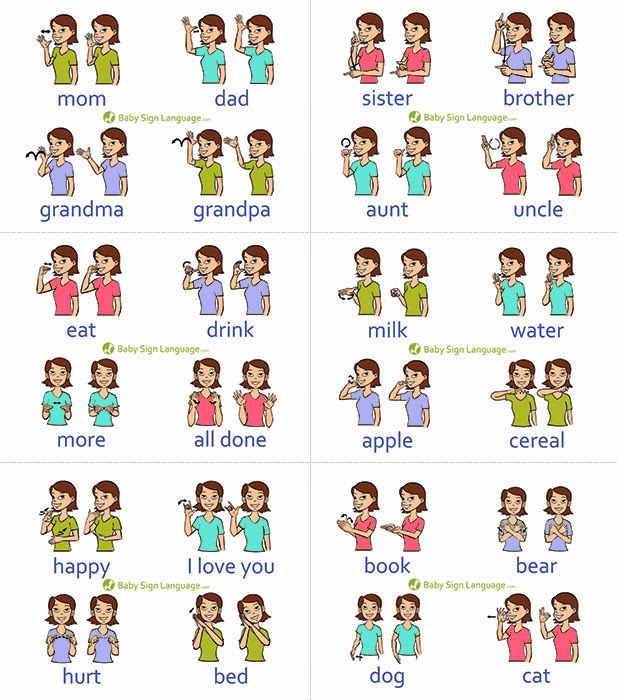
So where and when do you begin? Again, most babies understand simple words before they are able to say them. The motor functions of their lips, tongue, and mouth have yet to develop, and how frustrating must that be when you really want to say something. When it seems your infant can understand your words, it's time to teach them simple baby sign language. Start with words or phrases that are most motivating to the child. For example, teach them to sign the names of things (if you have a pet, teach them to sign "dog"; buckling your child in, teach them to sign "car"). Names of people, such as "Mommy" or "Grandpa" can be good starting points. Children are motivated to get attention. Teaching a baby to sign ownership ("mine") can also be a great starting point, because most babies are extremely materialistic toy hoarders. Think about your baby's most prevalant needs. Teach them to sign words that are important to them such as eat, hungry, more, milk, bathroom, hurt, play, toy, and even thank you.

Of course, while you teach them to sign, teach them to speak. Acknowledge a heavier understanding of their speach (when they're first learning to speak) so they understand that verbal communcation is a better way of expressing their needs than signing. Associate spoken word with hand gestures always when teaching them to sign. Teaching an infant with healthy hearing development to sign before they can speak is proven advantageous, so you've got nothing to lose. Here are some great gestures to start with:
 
Resources
Garcia, J. (2001). Which signs to start with and when to start. Sign with Your Baby: How to communicate with infants before they can speak (p. 31). Seattle, WA: Sign 2 Me and Bellingham, WAL Stratton Kehl Publications, inc.
Goodwyn, S.W., Acredolo, L.P., & Brown, C. (2000). Impact of symbolic gesturing on early language development. Journal of Nonverbal Behavior. 24, 81-103